
Make your dialysis emergency plan before the storm, not during it

September is National Preparedness Month, and it is also the busiest stretch of storm season in Georgia. If you are on dialysis, the plan you make this week is the one that protects you later.
Welcome to the September issue of Kidney Health Monthly. Last month we spent our time in the kitchen. This month we want to spend it at the kitchen table, with a pen and a single sheet of paper.
September is National Preparedness Month. It is also the stretch of the calendar when the remains of Atlantic storms most often push inland over Georgia, bringing the flooded roads, the downed trees, and the multi-day power outages we all remember. For most families that means an inconvenient week. If you are on dialysis, it can mean something more serious, and it is worth ten quiet minutes of planning now.
So this month we are handing the newsletter to the part of our practice that lives closest to this question.
Physician spotlight: Piyush Patel, MD
Dr. Piyush Patel is board-certified in Nephrology and Internal Medicine. He completed his Internal Medicine training at St. Luke’s-Roosevelt Hospital in New York and his nephrology training at Robert Wood Johnson University Hospital in New Jersey. Since 2008 he has served as Medical Director of the Snellville Dialysis Center, where he rounds on patients daily, and his practice centers on dialysis, chronic kidney disease, and hypertension. Patients tend to describe him the same way we do: warm, unhurried, and easy to talk to.
Nearly two decades of storm seasons at the same dialysis center teaches you something specific. The danger our dialysis patients face in a storm is almost never the wind. It is the treatment that gets skipped on Tuesday, and then the one on Thursday.

The short version
If you remember only three things from this article, make them these:
- The missed treatment is the risk. Storms hurt dialysis patients mostly by keeping them from dialysis.
- Ask about treating early. Getting your treatment moved up ahead of a forecast storm is a real, measurable protection.
- Write it down before you need it. A plan you have to invent during a power outage is not a plan.
Why a missed treatment is the real danger
Between treatments, fluid and waste products build up in your body. Dialysis clears them. When a storm interrupts that rhythm, the buildup keeps going anyway, and that is where the trouble starts.
The research on this is unusually clear, because researchers have gone back and studied what happened to dialysis patients after major hurricanes.
After Hurricane Katrina, investigators interviewed 386 patients from nine New Orleans hemodialysis units. Forty-four percent had missed at least one dialysis session, and nearly 17 percent had missed three or more. Patients who missed three or more sessions had roughly twice the odds of being hospitalized compared with patients who missed none. The study also found something we think about often: patients who were unaware of their dialysis facility’s emergency plans were more likely to be among those who missed three or more sessions.
After Hurricane Sandy, a large analysis of Medicare claims covering more than 13,000 patients with kidney failure in New York City and New Jersey found higher rates of emergency-department visits, hospitalizations, and 30-day deaths in the storm-affected area than in comparison groups. Nearly one in four of the affected patients who ended up in an emergency department received their dialysis there, in the ED, rather than at their usual chair.
Older adults carry more of this weight. A separate study of emergency-department use in New York City after Sandy found a significant rise in ED visits by adults aged 65 and older in the three weeks following the storm, and the increase was larger still in those aged 85 and over. Among the reasons they came in: dialysis, electrolyte problems, and prescription refills. Those are not exotic emergencies. They are ordinary care that a storm interrupted.
None of this is meant to frighten you. It is meant to explain why we make such a fuss about the plan. These are preventable problems, and the prevention is mostly paperwork.
Early dialysis: the single most useful thing to ask about
When a serious storm is forecast, many dialysis centers will offer to move treatments up, so that patients come in ahead of the weather rather than during or after it. This is often called early dialysis, and until recently it was simply considered sensible practice rather than something proven.
Then researchers tested it. In the Hurricane Sandy analysis, about 60 percent of nearly 13,800 hemodialysis patients in the hardest-hit areas received dialysis ahead of their usual schedule before the storm. Compared with patients who did not, those who dialyzed early had significantly lower odds of an emergency-department visit and of hospitalization during the week of the storm, and lower odds of dying within 30 days. That is about as encouraging as preparedness research gets.
What this means for you is refreshingly simple. When a storm is in the forecast, your dialysis center may call you to move your treatment up. Take the earlier slot if you possibly can. And if a storm is coming and nobody has called, call them. Asking is always reasonable.
Doctor’s tip: put your dialysis center’s phone number in your cell phone under a name you can find while stressed, such as “DIALYSIS.” Ask them whether they have a second number for storm days, when the main line may be down. Federal rules require dialysis facilities to give patients an alternate emergency phone number for exactly that situation.
The three-day emergency kidney diet
Here is the part most patients have never been shown, and it is the one that can carry you through a bad week.
If you cannot get to dialysis, what you eat and drink matters enormously, because your usual clearance is not happening. The National Kidney Foundation publishes a three-day emergency meal plan with a matching grocery list, written for exactly this situation. It is deliberately much stricter than your everyday kidney diet, because its whole job is to slow the buildup of potassium, phosphorus, urea, and fluid while you are without treatment.
The published sample plans provide roughly 40 to 50 grams of protein, 1,500 mg of sodium, 1,500 mg of potassium, and less than 500 cc (about 16 ounces, or 2 cups) of fluid per day. The tight fluid limit is there to keep you from swelling or becoming short of breath. If the disruption runs past three days, the plan is designed to be repeated from Day 1.
A few practical notes from that guidance:
- Keep shelf-stable groceries on hand year-round, and check the dates now and then so nothing expires quietly in the back of the pantry.
- If the power goes out, eat what is in the refrigerator and freezer first, then move to the shelf-stable food. Keep those doors closed except at mealtimes.
- Keep bottled or distilled water, a hand-operated can opener, disposable plates and utensils, and measuring cups so you can actually track that fluid limit.
We want to be plain about one thing: this diet is a bridge, not a substitute. It buys you time until you can get back to your chair. It does not replace a treatment.
Doctor’s tip: print the three-day plan and the grocery list this month and put them in the same folder as your medication list. Ask your dialysis dietitian to look them over with you, since your personal fluid and potassium targets may differ from the sample plan.
Your medication and records go-bag
If you have to leave your home, or if you end up dialyzing somewhere unfamiliar, the staff who see you will know nothing about you except what you brought with you. Make that a short, boring, wonderful list of facts.
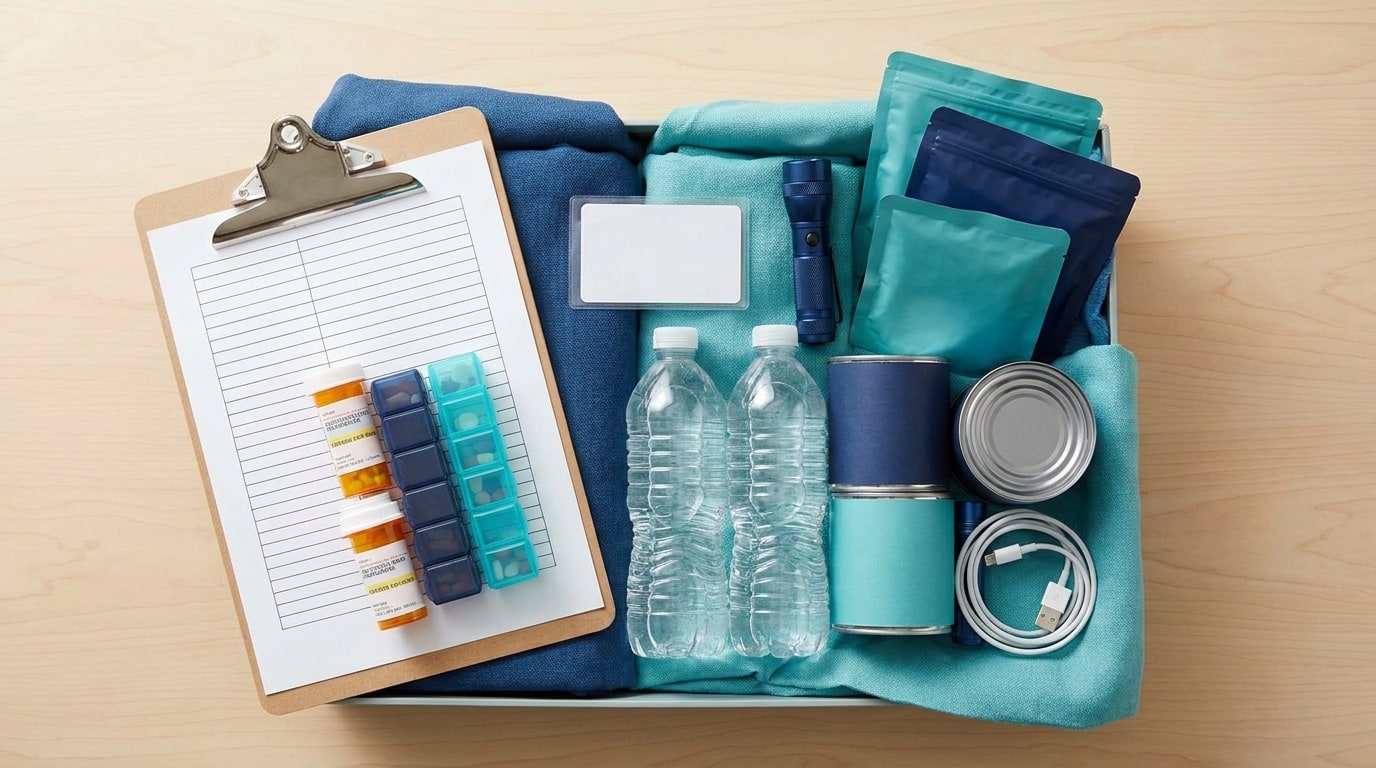
Based on the National Kidney Foundation’s emergency planning guidance, a good kidney go-bag holds:
- A current medication list with the doses, kept up to date and carried with you. Keep a copy at home and, if you work outside the home, a second copy at your job.
- A two-week supply of your medicines and vitamins at home, with expiration dates checked periodically. Diabetics should include enough insulin and testing supplies, plus spare glucometer batteries.
- Copies of your medical and insurance information, updated regularly. Your care team can help you assemble this if you ask.
- A written emergency phone list: your nephrologist, your dialysis unit, your dialysis unit’s alternate storm number, your local hospital, and a family contact.
- A medical ID emblem to wear, which tells emergency staff about your kidney condition and your treatment needs. Your social worker can help you get one.
- Flashlights and a battery-powered radio with spare batteries, plus a way to charge your phone. A car charger counts. Text messages use less battery and get through congested networks more reliably than calls.
Paper matters here more than people expect. Phones die, and cell service gets crowded exactly when you need it. A folded sheet of paper in a plastic bag works in a blackout.
Know your backup clinic, and know your Network
Your dialysis facility is not improvising. Under Medicare’s Conditions of Participation, dialysis facilities are required to maintain an emergency preparedness program built on an all-hazards risk assessment, including arrangements with other dialysis facilities to receive their patients if the facility has to limit or stop operations. Facilities are also required to inform patients what to do, where to go, whom to contact if an emergency happens while they are away from the unit, and how to safely disconnect themselves from the machine.
That last point is worth reading twice. Your center is required to teach you the emergency disconnect procedure. If you have never been shown, or you were shown years ago and would not feel confident today, ask at your next treatment. It is a completely normal thing to ask for.
Three questions to bring to your center this month:
- What is your emergency plan, and may I have a copy?
- Which facility would take me if this one closed, and where is it?
- Which ESRD Network covers Georgia, and what is its patient phone number? Your dialysis unit can tell you. Write it on your emergency sheet, because the Networks help patients find dialysis when their usual center is unavailable.
If you are on home dialysis
Home hemodialysis and peritoneal dialysis change the shape of the problem. Your treatment travels with you, but it depends on supplies, clean space, and sometimes electricity and water.
- Talk with your home training nurse now about how many days of supplies you keep on hand and how to store them somewhere dry and off the floor.
- Ask what your specific plan is if the power goes out mid-treatment, and make sure you have practiced the manual steps your program teaches.
- Report your storm damage or supply loss to your program early. Reordering takes longer after a regional storm than before one.
- If you evacuate, take supplies plus your medication list and records. If you cannot treat at home, your program can help arrange in-center backup.
The published review of what has gone wrong for hemodialysis patients after tropical cyclones around the world lands on the same conclusion every time: the fixes that work are unglamorous ones, made ahead of time. Written emergency plans, staff training, and patient education, done in the calm before, not the scramble after.
When to go to the emergency room
Please do not wait it out at home if something feels genuinely wrong. Call 911 or go to the nearest emergency department for:
- Chest pain or pressure
- Trouble breathing, or breathlessness when you lie flat
- A heartbeat that feels fast, irregular, or like it is skipping
- New or severe muscle weakness
- Confusion, fainting, or a level of drowsiness that is not like you
And if you have simply missed treatments and cannot reach your center, going to an emergency department is a legitimate use of it. Emergency departments can and do provide dialysis in these situations. That is not a failure of your plan. It is your plan’s last page.
From our physicians
We chose a spotlight this September rather than a research piece or a recipe because preparedness is one of the few areas of kidney care where a patient’s own paperwork changes the outcome. The evidence on early dialysis is a good example. Patients who came in ahead of Hurricane Sandy did measurably better, and all that took was a phone call answered and a schedule shifted by a day.
Our dialysis patients, and Dr. Patel’s patients in Snellville in particular, hear a version of this every September. Storms in Georgia rarely take the form people picture. More often it is a soaked, wind-battered Wednesday, a road closed by a fallen oak, a clinic without power, and a patient at home deciding whether Thursday’s treatment can wait. It usually should not.
So here is what we are asking of you this month. Fill out one sheet of paper. Put your dialysis center, its storm number, your nephrologist, your medication list, and your backup clinic on it. Add the three-day emergency diet and the grocery list behind it. Put the whole thing where your family can find it, and tell them where it is.
We are also asking something of ourselves. If a storm is heading for north Georgia, expect to hear from us and from your dialysis center about moving your treatment up. Please pick up the phone. And if you are ever unsure whether to come in, call and ask. We would far rather have that conversation on a Tuesday than meet you in an emergency department on a Friday.
Patient resources
- Ask for your center’s emergency plan at your next treatment, and ask them to walk you through the emergency disconnect procedure. Both are things your facility is required to provide.
- Print the three-day emergency meal plan and grocery list from the National Kidney Foundation, linked in our sources below, and review them with your dialysis dietitian so the fluid and potassium targets match your personal plan.
- Build the go-bag this month, while the weather is calm: medication list, two-week medicine supply, insurance and medical records, phone list, flashlight, radio, and a charger.
- On home dialysis? Ask your home training nurse about supply reserves and your power-outage procedure.
- Newer to all of this? Start with when do I need dialysis and the stages of kidney disease.
- Watching your diet between treatments? Foods to avoid with kidney disease covers the everyday version of what the emergency plan tightens.
Let’s make a plan together
If you are not sure what your own storm plan should say, or whether your medicines need adjusting when treatments get disrupted, that is a conversation for your KHC nephrologist rather than a checklist from the internet. Book an appointment and we will write it down together, this month, while the sky is clear.
This article is for general education and is not a substitute for personalized medical advice. Talk with your doctor or nephrologist about your specific situation.
Sources
- Anderson AH, et al. Missed dialysis sessions and hospitalization in hemodialysis patients after Hurricane Katrina. Kidney Int. 2009.
- Lurie N, et al. Early Dialysis and Adverse Outcomes After Hurricane Sandy. Am J Kidney Dis. 2015.
- Kelman J, et al. Dialysis care and death following Hurricane Sandy. Am J Kidney Dis. 2015.
- Malik S, et al. Vulnerability of Older Adults in Disasters: Emergency Department Utilization by Geriatric Patients After Hurricane Sandy. Disaster Med Public Health Prep. 2018.
- Yang F, et al. Treatment-related Problems and Countermeasures for Patients Undergoing Maintenance Hemodialysis Following Tropical Cyclones: A Scoping Review. Disaster Med Public Health Prep. 2024.
- National Kidney Foundation. Emergency Meal Planning for Patients on Dialysis (three-day emergency meal plan and grocery list).
- National Kidney Foundation. Planning for Emergencies: A Guide for People with Kidney Disease.
- 42 CFR 494.62. Condition of Participation: Emergency Preparedness (Medicare requirements for dialysis facilities). Electronic Code of Federal Regulations.
- American Kidney Fund. Three-day emergency meal plan for people on dialysis.