
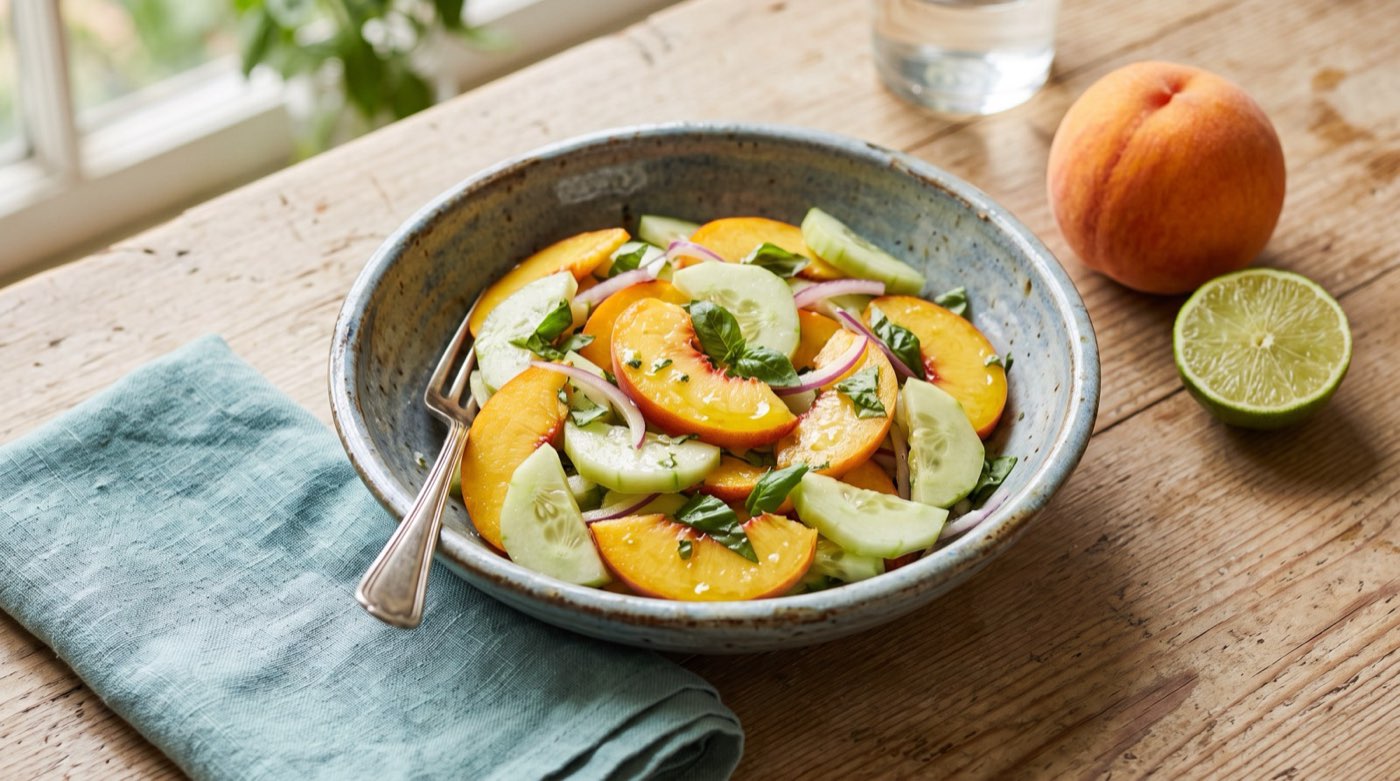
A Georgia peach and cucumber salad your kidneys will thank you for

It is mid-August in Georgia, the farm stands are piled with peaches, and eating well with kidney disease should not mean giving up summer flavor. This month, a recipe.
Hello from your kidney care team. Last month we talked about water and the summer heat. This month we want to talk about something more fun: food. Real, delicious, Georgia-in-August food.
If you have kidney disease, you have probably heard a lot of “no.” No salt. No bananas. No this, no that. Maybe you have stood at a farm stand wondering if anything there is still for you.
We hear this in clinic every week. So this month, instead of another list of things to avoid, we are handing you a recipe we would happily serve at our own tables: a peach and cucumber salad that takes 15 minutes and never touches the stove.
The short version
If you only remember three things from this article, make them these:
- Salt is the big one. Cutting salt is the single most proven food change for protecting kidneys. This salad has almost none, and you will not miss it.
- Fruit is usually not the enemy. For many of our patients, potassium does not need to be feared across the board. It depends on YOUR lab results, and we will tell you where you stand.
- Fresh beats packaged. Cook from the produce aisle and the hidden phosphorus problem mostly disappears on its own.
Why we picked this salad for you
”Will this raise my blood pressure?”
No, and it may actually help. Your kidneys and your blood pressure are in constant conversation, and salt is what usually turns that conversation into an argument. Research shows that when people with kidney disease cut back on salt, their blood pressure drops and their kidneys leak less protein. That is a real win.
This salad gets its flavor from lime, basil, honey, and black pepper instead of the shaker. A whole serving has less than 10 mg of sodium. A typical restaurant side salad? Often more than 400 mg.
Doctor’s tip: you stop missing salt faster than you think. Most people’s taste buds adjust in two to three weeks, and August produce makes that adjustment delicious.
”Wait, am I allowed to eat peaches?”
For most of our patients, yes. Here is the honest truth about potassium: the fruit you eat has a weaker connection to the potassium in your blood than most people assume. Your kidney function, your medicines, and conditions like diabetes matter more. That is why we adjust fruit advice to YOUR lab results instead of banning the produce aisle.
We still built this salad carefully. Cucumber is one of the lowest-potassium vegetables there is, and half a peach per serving keeps the whole bowl at about 270 mg per serving. For comparison, one banana has about 420 mg all by itself.
Doctor’s tip: on a strict potassium limit? Use one peach instead of two and add extra cucumber. That drops it to roughly 200 mg per serving. The swaps section below has more.
”What about phosphorus?”
Phosphorus is the sneaky one. It hides in sodas, deli meats, and packaged foods as an additive your body absorbs almost completely. The natural phosphorus in fresh produce, on the other hand, is only partly absorbed.
This salad has about 35 mg per serving, all natural, none added. When your food comes from a farm stand instead of a factory, the phosphorus math mostly takes care of itself.
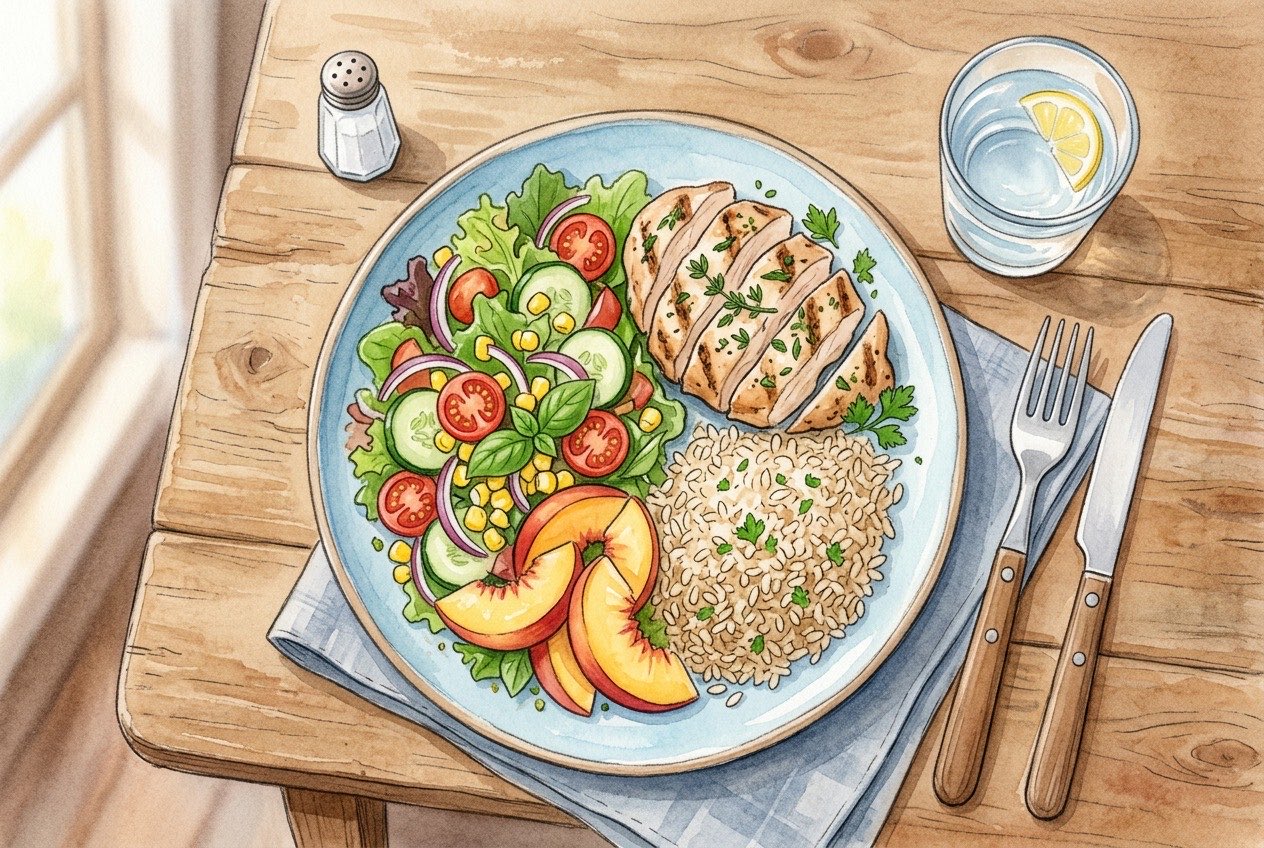
This is not just “allowed” food. It is helpful food.
There is a famous study called the DASH trial that proved something simple: a diet built on fruits and vegetables lowers blood pressure, substantially. And because high blood pressure both causes and speeds up kidney disease, food like this is not a consolation prize. It is part of your treatment.
The recipe
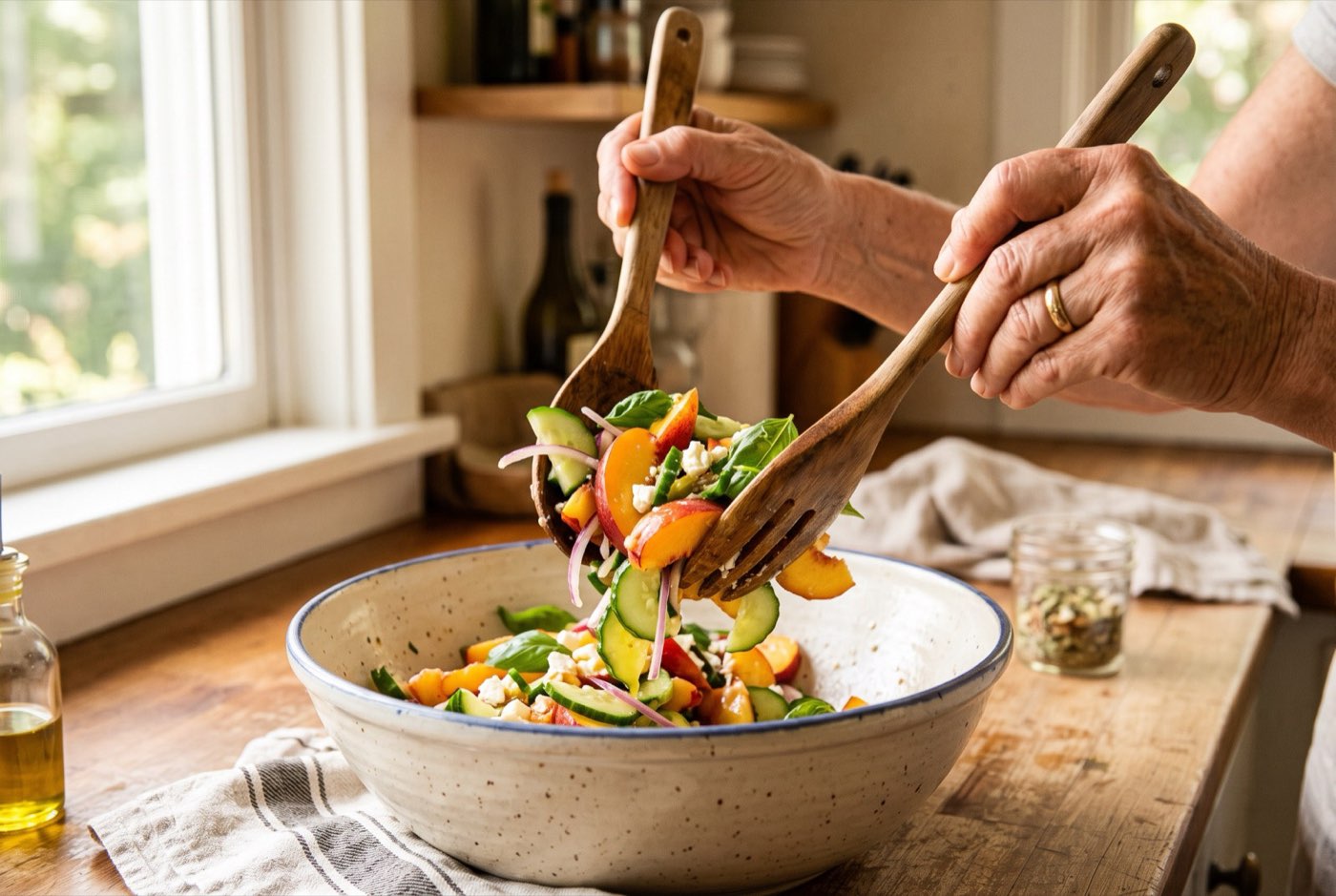
Georgia Peach and Cucumber Salad with Basil and Honey-Lime Dressing. Serves 4 as a side. About 15 minutes, no stove required, which matters in an Atlanta August.
The full recipe card, with the ingredient list, the steps, and our per-serving nutrition estimate, sits at the end of this article, easy to screenshot before you head to the store. The numbers in it are good-faith estimates from standard nutrient databases, without the optional feta; your dietitian can fine-tune them for your plan.
Make it yours
Everyone’s kidney plan is a little different, so here is how to bend this recipe to fit yours:
- Strict low-potassium plan? One peach instead of two, extra half cucumber. Roughly 200 mg per serving. Peeling the cucumber trims a little more.
- On dialysis? This works as an occasional side for most dialysis plans. One caution: juicy fruits and vegetables count a little toward your fluid allowance, so think of a serving as a few sips of fluid and stick to one serving. Your dialysis dietitian gets the final word.
- Watching fluids without dialysis? Same idea. This salad is refreshing because it is watery, which is exactly why it counts a little.
- Tempted by the feta? Two tablespoons across the whole bowl add about 30 mg of sodium and 15 mg of phosphorus per serving. Modest, but skippable if your limits are tight. Honestly, the salad does not need it.
- Diabetes in the picture? The honey is one teaspoon split across four servings. Drop it entirely if you like; ripe August peaches are sweet enough on their own.
Doctor’s tip: no single dish treats kidney disease, including this one. What protects you is the pattern: fresh food, no added salt, no processed additives. This recipe is simply that pattern on a plate.

A note from your doctors
We picked a recipe for August for a simple reason: this is the month Georgia’s produce is at its best, and it is also the month we hear the most food frustration in clinic.
So here is what we want you to take home. Salt is the restriction with the strongest evidence, and it is the one you will notice least while summer produce is doing the flavoring. Potassium is personal: some of you need to be careful, many of you do not, and the answer lives in your lab work, not on a list somewhere on the internet.
Before you strike peaches or tomatoes off your grocery list, ask us what your numbers actually say. We would much rather tailor the plan to you than have you eat a beige August. And if you make this salad, tell us how it turned out at your next visit. We mean that.
Keep going
- Want your personal potassium answer? At your next visit, ask what your last potassium level was and whether fruit portions need adjusting. Bring this recipe along if it helps the conversation.
- Label-reading trick: on packaged foods, scan the ingredient list for the letters “phos” (phosphoric acid, sodium phosphate). That is the additive phosphorus worth avoiding. Our article on foods to avoid with kidney disease goes deeper.
- Curious how blood pressure and kidneys feed each other? Read high blood pressure and kidney damage.
- On dialysis or heading there? Portions work differently; start with when do I need dialysis and talk with your care team.
Let’s make a plan together
If you are not sure which parts of the kidney diet apply to you, that is a lab-results conversation, not a guessing game. Book an appointment and we will build an eating plan around your numbers, your kitchen, and yes, your peaches.
Georgia Peach and Cucumber Salad with Basil and Honey-Lime Dressing
Ingredients
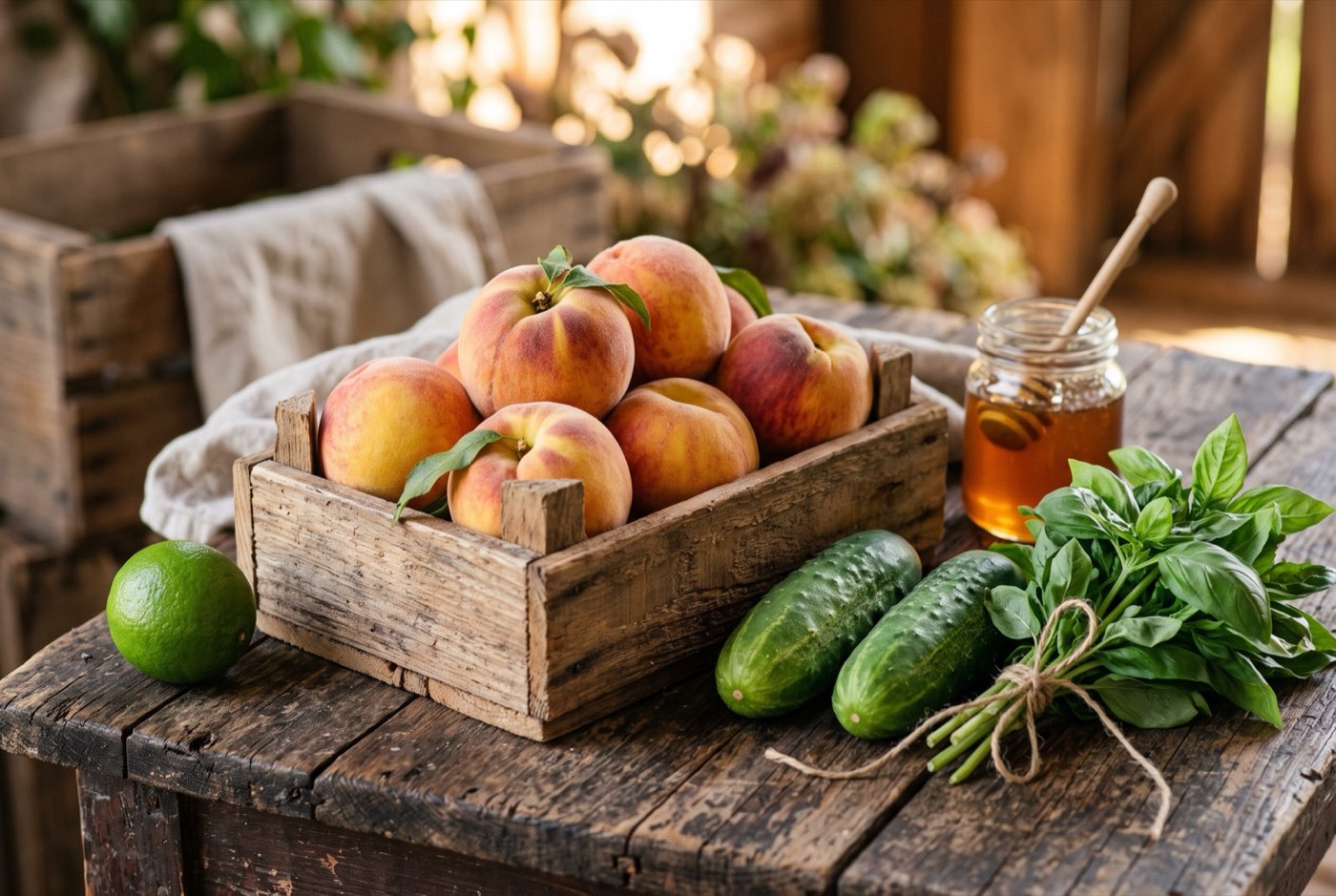
- 2 medium ripe Georgia peaches (about 10 ounces total), pitted and thinly sliced
- 1 large cucumber (about 10 ounces), thinly sliced into half-moons, skin on
- 1/4 small red onion, very thinly slivered
- 1 tablespoon extra-virgin olive oil
- 1 tablespoon fresh lime juice (about half a lime)
- 1 teaspoon honey
- 8 to 10 fresh basil leaves, torn (mint also works)
- Freshly ground black pepper, to taste
- Optional: 2 tablespoons crumbled feta for the whole bowl (adds flavor, but also sodium; see the swaps section)
Steps
- Whisk the olive oil, lime juice, honey, and a few grinds of black pepper in the bottom of a large bowl.
- Add the sliced peaches, cucumber, and red onion. Toss gently so the fruit stays intact.
- Scatter the torn basil over the top and give one more light toss.
- Let the salad sit for 5 minutes so the flavors mingle, then serve chilled or at room temperature. It is best the day it is made.
calories: about 80 kcalsodium: under 10 mgpotassium: about 270 mgphosphorus: about 35 mgprotein: about 1 g
This article is for general education and is not a substitute for personalized medical advice. Talk with your doctor or nephrologist about your specific situation.
Sources
- Ikizler TA, et al. KDOQI Clinical Practice Guideline for Nutrition in CKD: 2020 Update. Am J Kidney Dis. 2020.
- Garofalo C, et al. Dietary Salt Restriction in Chronic Kidney Disease: A Meta-Analysis of Randomized Clinical Trials. Nutrients. 2018.
- Appel LJ, et al. A clinical trial of the effects of dietary patterns on blood pressure. DASH Collaborative Research Group. N Engl J Med. 1997.
- Filippou CD, et al. Dietary Approaches to Stop Hypertension (DASH) Diet and Blood Pressure Reduction in Adults with and without Hypertension: A Systematic Review and Meta-Analysis of Randomized Controlled Trials. Adv Nutr. 2020.
- Ramos CI, et al. Does dietary potassium intake associate with hyperkalemia in patients with chronic kidney disease? Nephrol Dial Transplant. 2021.
- Kalantar-Zadeh K, et al. Understanding sources of dietary phosphorus in the treatment of patients with chronic kidney disease. Clin J Am Soc Nephrol. 2010.